How to Find Friendship Percentage on Paper: Easy Method
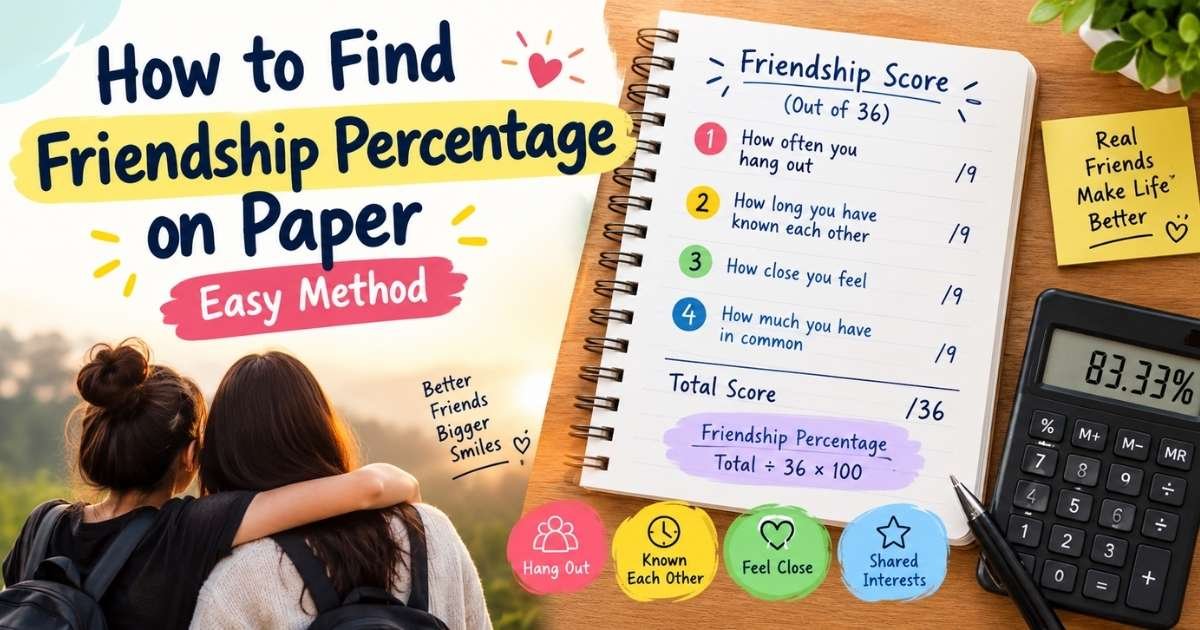
Want to know how to find friendship percentage on paper without using an online calculator? You can do it with a simple manual scoring method using a pen, paper, and a few honest answers about your friendship.
A commonly shared paper method uses four parts of a friendship, gives them a combined maximum of 36 points, and then converts the total into a percentage. However, there is no universally accepted scientific formula that says a friendship has a specific percentage score. The method below is best used as a simple, fun way to reflect on a friendship rather than as a psychological measurement.
Quick Answer: How to Find Friendship Percentage on Paper
To calculate a friendship percentage on paper:
- Write the names of the two friends.
- Rate four areas of the friendship.
- Add the four scores to get a total out of 36.
- Divide the total by 36 and multiply by 100.
For example, if the total is 30:
Your friendship percentage is approximately 83%.
The important part is understanding how to arrive at the score.
What You Need for the Paper Friendship Percentage Method
You do not need an app, website, calculator, or special chart.
All you need is:
- A piece of paper
- A pen or pencil
- Your name
- Your friend’s name
- Four honest ratings
The four areas used in the commonly shared paper method are:
- How often you hang out
- How long you have known each other
- How close you feel to each other
- How much you have in common
The original online guide that popularized this paper approach lists those four factors and says the points are divided by 36 to get the percentage. It does not, however, provide one universal scoring table for assigning the individual points. That is why the worksheet below gives you a clear 0–9 scoring scale so the calculation can actually be repeated consistently.
Step 1: Write Both Names on Paper
Start by writing the names of both friends at the top of the page.
For example:
Under the names, write these four headings:
- How often we hang out
- How long we have known each other
- How close we feel
- How much we have in common
Now you are ready to score the friendship.
Step 2: Score How Often You Hang Out
Think about how often you and your friend actually spend time together.
You may meet in person, talk on the phone, chat on WhatsApp, study together, go out after college, or simply make time for each other regularly.
Use this simple 0–9 worksheet:
| Frequency of Contact | Score |
|---|---|
| Almost never spend time together | 0–2 |
| Occasionally meet or talk | 3–4 |
| Stay in touch fairly regularly | 5–6 |
| Spend time together very often | 7–8 |
| Almost always stay connected | 9 |
This does not mean that friends who meet every day are automatically better friends. It is simply one input in this particular paper method.
For example, if you and your friend talk or meet regularly, you might give this factor 8 points.
Step 3: Score How Long You Have Known Each Other
Next, think about the age of the friendship.
Maybe you met in school, became friends in college, worked together, or started talking recently through a common group.
Use the following scale as a practical worksheet:
| Length of Friendship | Score |
|---|---|
| Very recently met | 0–2 |
| Known each other for a short time | 3–4 |
| Friendship has developed over time | 5–6 |
| Known each other for several years | 7–8 |
| Long-standing friendship | 9 |
The length of a friendship should not be confused with its quality. A new friend can become extremely close very quickly, while a childhood friendship can become distant over time. For this method, simply rate the duration honestly.
Suppose Riya and Kabir have known each other for several years. They might give this factor 7 points.
Step 4: Score How Close You Feel to Each Other
This part is about the emotional side of the friendship.
Ask yourself:
- Do you feel comfortable talking to each other?
- Can you share personal problems?
- Do you trust each other?
- Do you feel supported when something goes wrong?
- Can you be yourself around this person?
Use a 0–9 scale:
| Emotional Closeness | Score |
|---|---|
| Very little connection | 0–2 |
| Some connection, but not very close | 3–4 |
| Fairly close and comfortable | 5–6 |
| Very close friendship | 7–8 |
| Extremely close friendship | 9 |
This dimension has a reasonable connection with established friendship research. Scientific friendship-quality measures typically consider concepts such as closeness, companionship, help, security and conflict rather than reducing friendship to one percentage.
For example, if Riya and Kabir regularly support each other and can talk openly, they might give 9 points.
Step 5: Score How Much You Have in Common
Now think about the things you share.
You might have common:
- Hobbies
- Favourite music or movies
- Sports interests
- College or school experiences
- Sense of humour
- Interests and activities
- Goals or everyday preferences
Give this factor a score from 0 to 9:
| Things You Have in Common | Score |
|---|---|
| Very few similarities | 0–2 |
| A few things in common | 3–4 |
| Several shared interests | 5–6 |
| Many similarities | 7–8 |
| Strong overlap in interests | 9 |
Remember that having different personalities does not automatically make a friendship weak. Two friends can enjoy different hobbies and still have strong trust, support and communication.
Step 6: Add the Four Scores
Now add your four numbers.
For example:
| Friendship Factor | Score |
|---|---|
| How often we hang out | 8 |
| How long we have known each other | 7 |
| How close we feel | 9 |
| How much we have in common | 7 |
| Total | 31 / 36 |
The total is:
So the friendship score is 31 out of 36.
Step 7: Convert the Score Into a Percentage
Now use the formula:
For the example:
Rounded to the nearest whole number: 86%
So, under this paper worksheet, the friendship percentage is 86%.
For an instant result, try our Friendship Calculator.
Friendship Percentage on Paper: Worked Example
Let’s take another example.
Suppose Aarav and Meera give themselves these ratings:
| Factor | Score |
|---|---|
| How often they hang out | 7 |
| How long they have known each other | 8 |
| How close they feel | 8 |
| How much they have in common | 6 |
| Total | 29 / 36 |
First calculate the total:
Then convert it into a percentage:
Rounded: 81%
So their paper friendship percentage is approximately 81%.
Friendship Percentage Chart
There is no official scientific grading chart for a friendship percentage. The following is simply a practical interpretation for this worksheet:
These ranges should not be treated as clinical, psychological, or universally accepted categories.
A score is only as meaningful as the answers used to produce it.
What Does an 80% Friendship Score Mean?
An 80% result means that your answers produced a relatively high score under this particular paper method.
It may reflect things such as:
- Regular contact
- Strong emotional closeness
- Several shared interests
- A friendship that has lasted for some time
It does not mean that the friendship is scientifically “80% good.” Real friendship is more complicated than a single number. Research on friendship quality looks at multiple dimensions, including companionship, closeness, support, security, conflict and how friends deal with disagreements.
Is Friendship Percentage Scientifically Accurate?
Not as a universal scientific measurement.
The 36-point paper method is a simple informal scoring exercise. It is useful for a fun friendship test, a classroom activity, a conversation with your bestie, or simply thinking about your relationship.
It should not be confused with validated friendship-quality questionnaires used in research. For example, the Friendship Qualities Scale measures several distinct dimensions of friendship rather than assigning one universal friendship percentage.
So there is an important difference: paper friendship percentage is simple and informal, while scientific friendship-quality assessment is structured, multidimensional, and designed for a specific research purpose.
Friendship Percentage vs. Mutual Friends Percentage
These two calculations are not the same.
A friendship percentage in the paper method is based on ratings of the friendship itself.
A mutual friends percentage looks at how many friends two people have in common.
For example, suppose you have 30 friends and 6 of those people are also friends with another person.
The calculation would be:
That means 20% of the friends are shared. It does not mean that your friendship with that person is only 20%.
The two numbers answer different questions. The commonly shared friendship-calculator page also presents a friends-in-common calculation separately from its paper-based friendship method.
Can You Calculate Friendship Percentage Without a Calculator?
Yes.
The paper method is designed to be simple enough to do manually.
Write down the four scores, add them together, and use:
For example:
So a total score of 27 gives a friendship percentage of 75%.
You only need a calculator if you do not want to perform the division yourself.
How to Make Your Paper Friendship Score More Fair
Try to score each factor honestly instead of giving every category a 9.
For example, you may be extremely close to your friend but rarely meet because you live in different cities. In that case, your emotional-closeness score could be high while your hangout score is lower.
It can also be interesting for both friends to calculate their scores separately. One person might rate the friendship differently from the other, especially when it comes to time spent together or shared interests.
That difference does not automatically mean something is wrong. It may simply show that you experience the friendship differently.
Common Mistakes When Calculating Friendship Percentage on Paper
Mistake 1: Using 36 as the percentage
A score of 30 out of 36 is not 30%. You need to convert it: 30 ÷ 36 × 100 = 83.33%
Mistake 2: Forgetting that 36 is the maximum
The four factors together should add up to a maximum of 36 in this worksheet.
Mistake 3: Confusing mutual friends with friendship quality
Having many mutual friends does not automatically mean two people have a close friendship.
Mistake 4: Treating the result as scientific
This paper method gives you a fun score, not a validated psychological assessment. Scientific friendship measures use multiple structured questions and dimensions.
Mistake 5: Giving scores based on one bad day
A recent argument may affect how you feel today, but one disagreement does not necessarily describe an entire friendship.
Frequently Asked Questions
How do you find friendship percentage on paper?
Write the names of both friends, rate four friendship factors, add the scores, and divide the total by 36 before multiplying by 100. Formula: Total Score ÷ 36 × 100
What is the friendship percentage formula?
The simple formula used in this paper method is: Friendship Percentage = Total Score ÷ 36 × 100
What is the maximum friendship score on paper?
The maximum is 36 points in this commonly shared four-factor paper method.
Can I calculate friendship percentage without an online calculator?
Yes. You can calculate it with paper and a pen by rating the four factors, adding the scores, and applying the percentage formula. You can also use our Friendship Calculator for an instant result.
Is an 80% friendship score good?
Under the simple interpretation used in this worksheet, 80% falls in the strong friendship range. However, these ranges are not official scientific standards.
Is friendship percentage scientifically accurate?
No universal friendship-percentage formula has been established as a scientific measure. Research-based friendship assessments generally use structured, multidimensional measures of friendship quality.
Is friendship percentage the same as mutual friends percentage?
No. Friendship percentage in this paper method is based on friendship ratings, while mutual-friends percentage measures the proportion of people two individuals have in common.
Final Thoughts
Learning how to find friendship percentage on paper is easy once you break the calculation into four simple parts.
Write down the four friendship factors, give each one an honest score, add the points to get a total out of 36, and then use:
The final percentage can be a fun way to compare answers with your best friend, school or college friend, childhood friend, or someone you regularly talk to.
Just remember that a friendship is much bigger than a number. Trust, communication, support, closeness, shared experiences and the way two people handle disagreements all matter. A paper score can be a fun starting point for a conversation, but it cannot capture the full quality of a real friendship.
Try Our Friendship Calculator
Prefer an instant result? Try our free online tools for friendship and love compatibility.