Chaldean vs Pythagorean Numerology
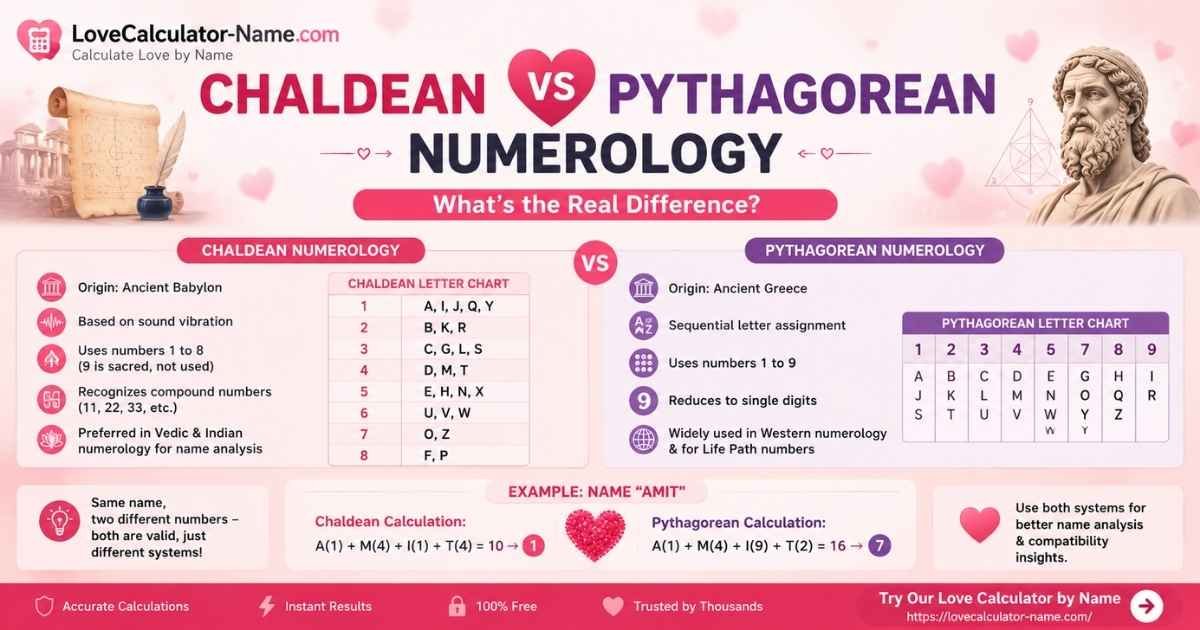
Quick answer: Pythagorean numerology (Greek origin) assigns numbers to letters sequentially — A=1, B=2, C=3, all the way to Z — and is simple, mathematical, and widely used in the West. Chaldean numerology (Babylonian origin) assigns numbers based on the sound vibration of each letter, uses only 1–8 (the number 9 is treated as sacred and left out), and works with compound numbers. Most Vedic numerologists in India prefer the Chaldean system for name analysis, while the Pythagorean system is more commonly used for calculating your Life Path number from your date of birth.
If you’ve ever run your name through two different numerology calculators and gotten two completely different numbers, this is why — you weren’t using the same system.
What Is Pythagorean Numerology?
Pythagorean numerology is attributed to the Greek philosopher Pythagoras and is the system most people encounter first, especially in Western apps and calculators. It’s built on a simple 1–9 grid where every letter of the alphabet gets a number in strict sequence:
A=1, B=2, C=3, D=4, E=5, F=6, G=7, H=8, I=9, J=1, K=2 — and the pattern repeats all the way through Z.
Because the assignment is sequential rather than based on meaning, it’s easy to calculate by hand and easy to explain. It treats every letter equally and doesn’t attach any special status to particular numbers — 9 is just another digit here, not a sacred one.
What Is Chaldean Numerology?
Chaldean numerology traces back to ancient Babylon, making it one of the oldest known numerology systems — older than the Pythagorean method by roughly two thousand years. Instead of going in alphabetical sequence, it assigns numbers based on the vibration or sound each letter carries when spoken. Two letters that sound similar can end up with the same numeric value, even if they’re far apart in the alphabet.
Chaldean vs Pythagorean: Side-by-Side
| Feature | Pythagorean | Chaldean |
|---|---|---|
| Origin | Ancient Greece (~2,500 years old) | Ancient Babylon (~4,000+ years old) |
| Letter assignment | Sequential (A=1, B=2, C=3…) | Based on sound/vibration |
| Number range | 1–9 | 1–8 (9 is sacred, excluded) |
| Compound numbers | Usually reduced to a single digit | Treated as meaningful on their own |
| Common use | Life Path number, general personality | Name analysis, business names, Vedic compatibility |
| Complexity | Simple, easy to learn | More nuanced, sound-based logic |
So Which One Is More Accurate?
There isn’t a single, universally agreed-upon answer — and any calculator that claims one system is “scientifically proven” better is overstating it. What’s fair to say is that the two systems are built on different logics and tend to be used for different purposes.
In numerology traditions, Chaldean is often considered more precise for name-based readings because it factors in how a name actually sounds when spoken aloud — which is a big part of why it’s the preferred system in Vedic numerology across India. Pythagorean, on the other hand, is generally favored for birth-date-based calculations like your Life Path number, where a simple, consistent sequence works well.
Rather than picking one as “correct,” many experienced numerologists in India actually use both — Chaldean for a name’s vibrational meaning, Pythagorean for date-based life patterns — and read them together for a fuller picture.
Try both systems with our Name Numerology Calculator and see the difference for yourself.
A Worked Example
Take the name “Amit”:
Same name, two different core numbers — neither is “wrong.” They’re simply measuring the name through two different lenses.
Which System Should You Use for Love & Name Compatibility?
This is exactly why a name-based love calculator that leans only on one system can miss half the picture. A name that scores well under Pythagorean logic might show a completely different compatibility pattern under Chaldean sound-vibration analysis — and in Vedic traditions, the Chaldean reading is usually weighted more heavily for relationship and compatibility questions specifically because it reflects how names are actually spoken between two people, not just their alphabetical position.
That’s the gap most simple calculators leave open — and it’s why combining both systems, rather than defaulting to just one, gives a more complete compatibility picture.
Try our Love Calculator by Name, which uses both Chaldean and Pythagorean systems for a fuller reading.
Frequently Asked Questions
Is Chaldean numerology more accurate than Pythagorean?
Neither is objectively “more accurate” — they’re different systems built on different logic. Chaldean is generally preferred for name-based readings in Vedic traditions; Pythagorean is more common for date-based calculations like Life Path number.
Why doesn’t Chaldean numerology use the number 9?
In Chaldean tradition, 9 is considered a sacred, complete number. Since adding 9 to any digit doesn’t change its final reduced value, it’s kept separate rather than assigned to letters.
Can my Chaldean number and Pythagorean number be different for the same name?
Yes, almost always. The two systems assign different values to the same letters, so it’s normal — even expected — for the results to differ.
Which system do Indian numerologists typically use?
Most Vedic numerologists in India favor the Chaldean system for name analysis and compatibility, since it’s rooted in sound and phonetics, which lines up closely with Sanskrit-based naming traditions — while still referencing Pythagorean methods for birth-date calculations.
See the Difference for Yourself
Run your name through both systems with our Name Numerology Calculator and see how the results compare.
Or check your compatibility with our Love Calculator by Name, which combines both systems for a fuller picture.