How to Interpret Your Love Percentage Meter
A love percentage meter gives you a simple compatibility score based on two names. But when the result appears on your screen, the obvious question is: what does the percentage actually mean?
Is 90% a perfect match? Is 50% a bad result? Does a score below 30% mean two people are incompatible?
Not necessarily. A love percentage is best understood as a fun compatibility indicator, not a guarantee about a real relationship. The meaning of your result depends on where it falls on the score range.
Here is what each range generally means.
What Does a Love Percentage Meter Mean?
A love percentage meter compares two names and generates a compatibility score, usually from 1% to 100%.
The higher the percentage, the stronger the compatibility result according to the calculator’s calculation method. A lower percentage indicates a weaker match within that system.
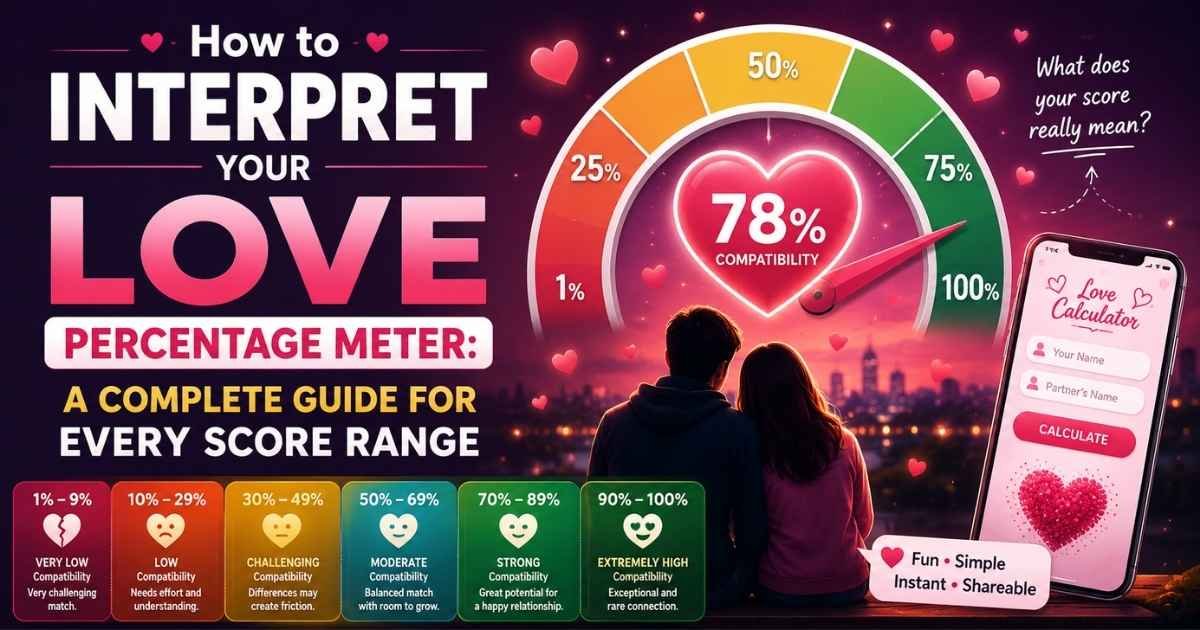
| Love Percentage | General Meaning |
|---|---|
| 90–100% | Extremely high compatibility |
| 70–89% | Strong compatibility |
| 50–69% | Moderate compatibility |
| 30–49% | Challenging compatibility |
| 10–29% | Low compatibility |
| 1–9% | Very low compatibility |
These ranges help explain the result, but they should not be treated as predictions about whether a relationship will succeed.
90–100%: Extremely High Compatibility
A result between 90% and 100% is the highest range on a typical love percentage meter.
If you receive 92%, 96%, or even 100%, the calculator is showing a very strong compatibility result for the two names. This is usually the range people hope to see when testing their names with a crush or partner.
A score this high can be interpreted as a strong natural match according to the calculator. It may suggest that the two names produce a highly compatible result within the meter’s calculation.
However, 100% does not mean a relationship will be perfect. The percentage is still only a calculator result. It cannot account for every personal quality or circumstance between two people.
So if you get a score in this range, enjoy the result, but don’t treat it as proof that the relationship is guaranteed to work.
Simple interpretation: Very strong match with a highly positive compatibility score.
70–89%: Strong Compatibility
A score from 70% to 89% represents a strong compatibility range.
For example, if your result is 78%, the calculator is indicating a good level of compatibility between the two names. It is a positive result without being in the very-high 90–100% range.
This range can be especially interesting if you’re checking the result for someone you already like. A score in the 70s or 80s suggests that the calculator sees a favorable connection between the names.
At the same time, there is no need to compare an 82% result with a 95% result and assume that the 95% couple will automatically have a better relationship. The percentage only describes the result produced by the calculator.
Simple interpretation: A strong and favorable compatibility result.
50–69%: Moderate Compatibility
A result between 50% and 69% falls in the middle of the love percentage scale.
Many users see a number such as 55% or 63% and immediately think the result is poor. That’s not what the middle range necessarily means.
A 50–69% score indicates moderate compatibility according to the meter. There may be both compatible and less-compatible aspects within the calculation, resulting in a score around the middle.
For someone testing a crush or partner, this range shouldn’t automatically be viewed as a negative result. A percentage calculator doesn’t know the complete circumstances of two people’s relationship.
The important point is that a middle score is neither an exceptionally high match nor an exceptionally low one.
Simple interpretation: An average or balanced compatibility result with room for differences.
30–49%: Challenging Compatibility
A score between 30% and 49% is generally considered a lower compatibility range.
If your result is 42%, the calculator is indicating that the two names don’t produce a particularly strong compatibility score. That may seem disappointing, especially when you’re testing the name of someone you have feelings for.
But a lower score doesn’t mean that two people cannot get along.
The calculator is working according to its own formula. It cannot measure every aspect of a real relationship or determine how two people actually interact.
Therefore, a 35% result should be interpreted as a lower calculator score, rather than a prediction that the relationship will fail.
Simple interpretation: A lower match according to the meter, but not a definite relationship verdict.
10–29%: Low Compatibility
A result between 10% and 29% is considered a low compatibility score.
For example, receiving 18% may indicate that the calculator finds relatively little compatibility between the two names under its calculation method.
This is the point where it’s especially important not to take the number literally.
A love percentage meter doesn’t know your personal connection, shared experiences, or feelings. It simply processes the names you enter and produces a score.
If you’re testing the name of your crush and receive 20%, there’s no reason to assume that the person is automatically wrong for you. The result can simply be treated as an interesting or unexpected outcome.
Simple interpretation: Low name-based compatibility according to the calculator, but not a prediction of relationship failure.
1–9%: Very Low Compatibility
A score between 1% and 9% is the lowest range.
A result such as 3%, 5%, or 8% can certainly be surprising, particularly if you expected a high score. It may even be fun to compare such a low result with what you actually think about the person.
This range means that the calculator has produced a very low compatibility score for the two names.
It does not mean there is zero possibility of a relationship. The percentage shouldn’t be used to make serious decisions about another person.
If the result doesn’t match your real-life experience, that’s simply a reminder that a calculator cannot capture every factor involved in human relationships.
Simple interpretation: Very low compatibility score from the meter, best treated as an entertaining result.
Love Percentage Score Chart
For a quick reference, you can interpret your love percentage meter result like this:
| Love Percentage | Interpretation |
|---|---|
| 90–100% | Extremely high compatibility |
| 70–89% | Strong compatibility |
| 50–69% | Moderate compatibility |
| 30–49% | Challenging compatibility |
| 10–29% | Low compatibility |
| 1–9% | Very low compatibility |
The score tells you where your result falls on the calculator’s compatibility scale.
Does a Higher Love Percentage Mean More Love?
No. A higher percentage does not automatically mean more love.
For example, a couple receiving 90% isn’t necessarily more in love than a couple receiving 60%. The calculator’s percentage is based on its own compatibility formula, while real relationships involve many things that a simple meter cannot measure.
A high score can make the result more exciting, but it shouldn’t be confused with a measurement of someone’s actual feelings.
Likewise, a low score doesn’t prove that two people won’t work together. The percentage is simply the result generated from the names entered into the calculator.
What If Your Love Percentage Is Lower Than Expected?
Don’t worry if the number isn’t what you expected.
People often enter two names expecting a high result and get a surprisingly low percentage. Others may expect a poor match and receive a score in the 80s or 90s.
The best way to handle an unexpected result is to treat it as part of the fun.
You don’t need to change spellings, repeatedly test the same names, or search for a different percentage just because you didn’t like the first result. If the same names are entered into a consistent calculator, the result should remain consistent.
Instead, simply take the score for what it is: an entertaining compatibility result based on the calculator’s method.
Interesting, not absolute.
Your love percentage gives you a quick and entertaining way to check the compatibility between two names. Whether your result is 98%, 76%, 58%, 35%, or 7%
The most important thing is understanding what that range represents without treating it as a definite prediction.
Use the score to have fun, compare results, and start a conversation — but let the actual relationship speak for itself.